Author: jmlittlejohn
-

Authentic Assessments in Online Classes
Authentic Assessments in Online Classes The landscape of higher education is rapidly evolving, especially in the realm of asynchronous, 100-level college classes. These foundational courses often set the tone for a student’s academic journey. As such, the need for authentic assessment – a method that evaluates students’ abilities in ‘real-world’ contexts – has become increasingly…
-

The Welcoming Syllabus
The course syllabus is more than a simple contract or informational document for the students. The syllabus serves many purposes: Welcomes students to the course, Provides information (such as learning outcomes and prerequisites) to let students know if the course is a good fit, Provides information to understand how the course aligns with other courses…
-

Active Learning in Zoom
Active Learning in Zoom Blog Post August 2020 Active Learning Active learning, in which students participate in the learning process by discussing, problem-solving, questioning, and interacting, combines focusing on how students learn with what students are learning. Thirty years of research has proven that active learning techniques significantly reduce students’ probability of failure while making…
-

Dispelling Neuromyths
Neuromyths – misconceptions about about learning and/or how the brain works – plague higher education. How often have you heard someone refer to themself as “left-brained”, or “a visual learner”, or “using only 10% of their brain”? It may seem harmless, but neuromyths persist because people not only believe them, they pass them on to…
-
Using Mastery Quizzes in Online History Classes
Teaching history survey courses online has its challenges, but ensuring that students attain the foundational knowledge required to move onto assignments requiring higher order thinking skills is not challenging if the instructor can implement adaptive, mastery quizzing. On our campus we use WWNorton Publishing for many of our history textbooks, and Norton has a quiz…
-

About HyFlex Courses
SUNY, the State University of New York, has announced its current working definition of HyFlex courses: “Combines online and face-to-face instruction simultaneously into one single course section, with the mode of direct instruction determined by each individual student. Students are able to choose how to participate in any given class meeting – online or face-to-face.”…
-
Understanding by Design
Best practices for Online, Hybrid, and HyFlex courses Bowen, Ryan S., (2017). Understanding by Design. Vanderbilt University Center for Teaching. Retrieved [July 12, 2018] from https://cft.vanderbilt.edu/understanding-by-design/. Overview The Benefits of Using Backward Design The Three Stages of Backward Desgin The Backward Design Template Overview Understanding by Design is a book written by Grant Wiggins and…
-
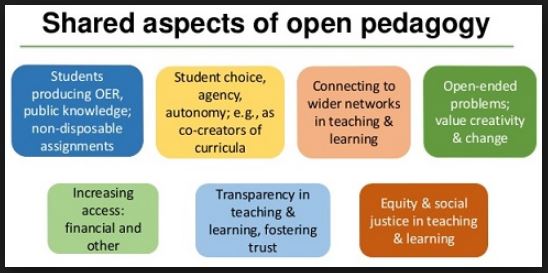
About Open Pedagogy
The idea of “open” in higher education confuses many, partly due to the varied terms thrown around – OERs, MOOCs, open education – but mainly due to the assumption that “OERs” (open educational resources) and “open pedagogy” are the same thing. Open educational resources (OERs) are the texts, quizzes, maps, blogs, videos, podcasts, websites, or…
-

How to Add the GCC Course Policies Module to Your Blackboard Course
With recent changes to the Plagiarism Policy and the Accessibility Statement, plus the importance of including the Student Code of Conduct and the No-Show Reporting Criteria in courses, we’ve created one module that you can use to efficiently share this information with your students. Here is how you can add it to your Blackboard courses:…
-

Copyright and Course Content
Break time between semesters is a great time to review and update course materials. It’s easy to grab images and articles from the web, but, how can we be sure to do so legally? Here are some guidelines and resources to help ensure you are not breaking any laws when adding images, articles, videos, power…
-

Why Grading Makes Us Anxious Too
“There is nothing more demoralizing than the thought that the countless hours we spend grading might be dismissed as meaningless.” – Elizabeth Barre
-

Helping Students Articulate Knowledge and Skills
Students, and particularly those in the humanities, arts, and social sciences, often struggle to articulate their knowledge and skills to prospective employers. Help them learn how.
 Beyond another Paper